Friday, November 21, 2014

Week 14: Urinary Elimination

This week, we learned the extremely fascinating concepts of urinary and bowel elimination. (Also known as peeing and pooping... Riveting, I know.) Since there was so much information in this topic, I decided to just share some of the fun highlights or weird tidbits we learned.

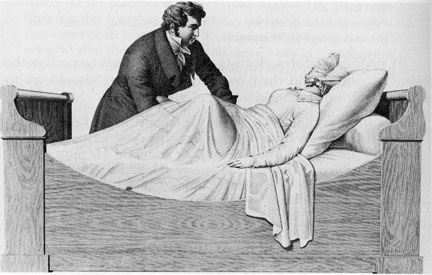
Did you know that if someone's having trouble urinating, you can pluck their pubic hair and that can stimulate them to go?


Did you know that old men frequently have problems urinating because their prostate enlarges and pinches their urethra?


Did you know that it is better anatomically for men to stand while urinating and women to sit?


Did you know UTIs (urinary tract infections) are the most common health care acquired infection?

Sometimes I'm shocked this dummy isn't blonde....
Did you know most people only urinate 5x per day (after waking, after each meal, and before bed)?


Did you know that your eyes turn red in a swimming pool from the combination of urine and chlorine in the water? (And did you subsequently know that most people urinate in the swimming pool?!)


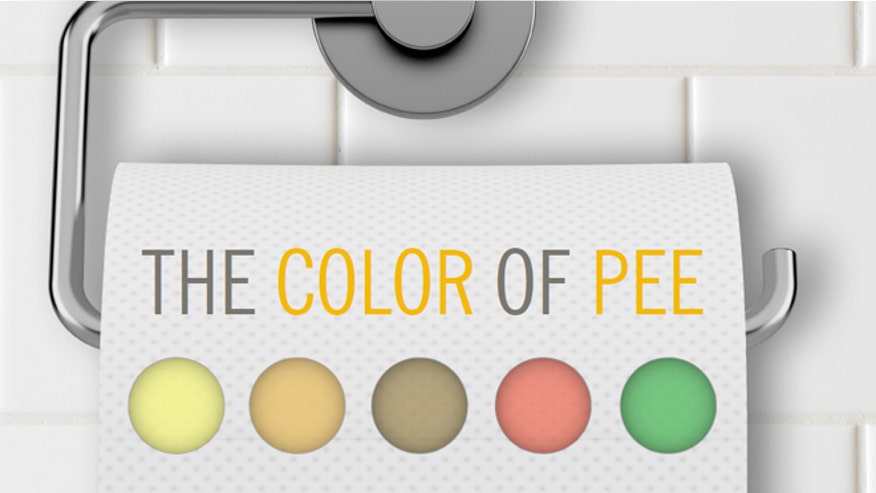
Did you know certain medications can change the color of your urine? Depending on what medication you're taking, it could be perfectly acceptable to have blue, green, or orange urine!


Did you know some people believe that urine can heal diseases? If they're sick, they'll mix a drop of urine with water and drink it. Some people claim it really works! (Personally, I think "Eeeewwww!!!")


Next week, I just have a test and a nutrition project presentation and then I'm off for Thanksgiving so there'll be no post next week.

Happy Thanksgiving!


Week 13: Stress!!!!!!!

This week, we learned about stress and coping. The joke at school was that we needed to learn about this topic 13 weeks ago....

There are two different types of stress - eustress (good stress) and distress (bad stress). Eustress causes someone to get the job done and work hard. It brings about positive results. Distress causes someone to freak out and overload and have a melt down. It brings about negative results and eventually causes the person to crash and burn.

...this is what my nursing class looks like half the time.
So the question was asked: Is nursing school a eustress or a distress?


There were multiple opinions expressed about the stress of nursing school. Some people said it was distress since it was just too much and there were too many assignments and they couldn't pass tests and they were starting to get ulcers from the constant stress and they were working part time and trying to raise their family and they don't know how they're going to make it. Other people said that nursing school was eustress since it was stressful enough that we are constantly studying making us better students and eventually better nurses.

When someone is under stress, there's three phases. The first phase is the alarm reaction phase, where their body responds to the stress and the fight or flight response occurs. If it lasts long enough, it moves to the second stage, the resistance stage. In this stage, the body stabilizes and tries to adjust to the stresser. The stress is still there but the body is no longer responding to it. After a while, it moves into the third phase - exhaustion. At this point, the body is so worn down that it gives up. It doesn't have any more energy and becomes ill.

Of course, this week we had a really big skills check off and 31 out of the 39 students failed. It wasn't exactly our fault since there's a ton of miscommunication between students and teachers. Thankfully, the problems are starting to be resolved and everyone passed the re-check off!

...Until next week!

Monday, November 10, 2014

Week 12: Family

This week, we learned about the concept of family. We also learned about tissue integrity and wound care, but it was boring and I decided family would be much more interesting. :)

There wasn't really anything earth shattering I learned so I'll just quickly post some fun facts:

The "typical" family (mom, dad, kids) is no longer the norm. There's now single parent families, blended families, alternative families, and extended family groupings.


26% of households are just one person living alone.


54% of marriages end in divorce... :(


41% of children live with single moms who've never married (I personally found this number shocking)

I couldn't find a good picture for this, so I just found a funny picture that has absolutely nothing to do with single moms.
24% of children have their fathers as their main caretaker (I find this number hard to believe...)


Being 65-years-old is no longer considered "old," but "middle aged."

party time!
...Well, that's the interesting facts from this week! Until next week!

Friday, October 31, 2014

Week 11: A Wonderful Week and Medication Administration

Last week, I was really discouraged at the end of the week because it had been a long, stressful, fairly unpleasant week. The teachers had yelled at us due to miscommunications (every class...), I failed a nursing skill, and we had a test I needed to be studying for. And, we got dispatched to a surprise cardiac arrest (as in, we were told it was an allergic reaction instead of a dead person) five minutes before we could call out of service Saturday night. Ok, so that was actually pretty exciting (it was my first code!) but the adrenaline crash afterward was pretty horrible... lol.

I just learned about how to put .gifs into Blogger so this post will be full of them... :-D

However, this week was wonderful - I aced my test on Monday (yay!), passed my skill test (yay!), the teachers were nice to us this week (yay!), my group got a lot accomplished for our nutrition project presentation due the week of Thanksgiving (yay!), and I got hired to photograph a guy proposing to his girlfriend on Saturday (yay!). This week was a wonderful respite from last week. :-D


Anyway, this week we learned about medication administration. I thought it would be fun to share some of the weird facts I learned this week:

Don't ever give ear drops to someone if they're cold. You need to roll them between your hands for a few minutes to bring the drops to room temperature. The middle ear is super sensitive to temperature and cold ear drops will cause the patient to have nausea, vertigo, and debilitation for a few minutes!

Fainting goats :)

When giving an injection, it should take 10 seconds to inject 1 mL. Yesterday, we had to pretend to give an injection of 2.5 mL so yes, it took us 25 seconds to give this shot!

1...2...3...4...5...6...7...etc...
If a patient uses a Metered Dose Inhaler (MDI), they need to rinse their mouth out two minutes later so fungus doesn't grow in their mouths.


There are between 600,000-1,000,000 accidental needle sticks of health care providers reported each year...


Insulin has to be given by injection instead of orally because the GI tract digests insulin before it can do any good.

I couldn't find a good gif for this so I decided to post a funny gif of the Kardashians because they're dumb.
Well, folks, that's it! :-D

...Until next week!


Friday, October 24, 2014

Week 10: Infection. Inflammation, and Bacteria - Oh My!!!

In week 10, we studied infection and inflammation.

Of the two, inflammation is the more general and can occur with or without infection. Slam your toe against a wall? Inflammation! Get a splinter? Inflammation! Get Tuberculosis? Infection and inflammation! It's a party! Ok, maybe not...

Anyway, inflammation is what causes the pain, redness, and swelling from an injury or illness. Let's say you were building a wooden fort and accidentally hammered a nail into your finger. Ouch! From the outside, your finger really hurts, a giant nail is sticking out of it, and it is probably bleeding.

This is actually a prank kit you can buy - the nail is not actually puncturing her finger!
On the inside, your white blood cells (WBCs) are flooding to the scene of the trauma, trying to ascertain whether any bacteria entered. Most likely, there are several foreign bacteria who entered with the nail. Your white blood cells start attacking the bacteria and call for help. One type of WBC releases histamine (which constricts veins, decreasing venous return), heparin (which decreases clotting abilities), and kinins (which dilate arteries).


The arteries bring blood to the area while the veins take blood away from the area so having dilated arteries brings more blood to the scene of the crime. However, the veins are smaller so it is harder for the blood to leave. This causes the redness you see in inflammation.

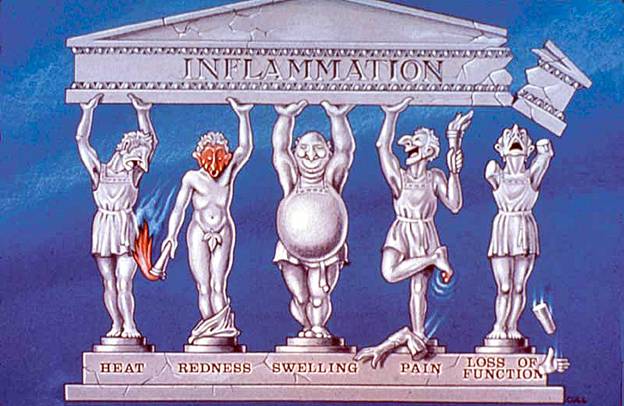
The 5 Pillars of Inflammation

Since all the blood is staying in the area, the area begins to grow and swell causing edema. Since the area is growing, this puts pressure on the nerves in the area which causes the pain involved in inflammation. Also, the edema and pain causes the person to not move the area as much so the last sign of inflammation is loss of function.


So there you have inflammation in a nutshell! :-D


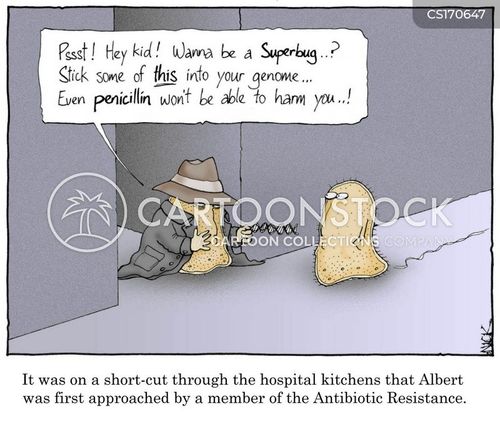
Another very important topic we talked about was antibiotic resistance. Antibiotic resistance has become a huge problem lately because bacteria are smart and can easily figure out how to change so that the antibiotic is no longer effective on them. This can be caused by people taking antibiotics when they don't need to or by taking antibiotics for a little bit and stopping before the bacteria is fully killed. Either way causes bacteria to build up resistance to the antibiotics which makes it really hard to kill the bacteria. One famous example of an antibiotic resistant bacteria is MRSA - Methicillin-resistant Staphylococcus aureus. MRSA starts looking like a harmless spider bite but then it progresses and becomes really bad, eventually killing the person if it's not treated and stopped in time.

Harmless spider bite? Maybe not!
Anyway, almost all antibiotics have bacteria that are resistant to them. So the moral of the story, folks, is be careful with your antibiotics! If your doctor prescribes antibiotics for you, take them until they're completely gone! Don't just stop taking them because you "feel better!" You aren't just harming yourself, you're also harming everyone else around you who might get your newly antibiotic-resistant bacteria!


...Until next week!

Week 9: Quality Informatics

This week, we had fall break for a few days but still had to go to school Wednesday. We learned about quality improvement and different ways health care errors happen. Did you know that health care errors are the 8th leading cause of death in the United States?! I hadn't realized they happened that frequently. These last few weeks, I've noticed that hospitals are not near as safe as I once thought they were! The chances of you acquiring another infection or experiencing an error are extremely high! In fact, we learned that 1 in 20 inpatients will experience a hospital acquired infection. That is an extremely high number!

Healthcare Acquired Infections by the percentages.

I had absolutely no idea what to write for week 9 (because, if you haven't noticed, I'm writing it a week late) but got my inspiration during clinicals. During clinicals on Thursday, I saw a few quality improvement mistakes. I'll tell you about the first one.

My patient had a precautions sign on her door which warned anyone entering to put on PPE (gown, gloves, and mask). She had C. diff (a horrible diarrhea infection) which is highly contagious. I put on full PPE and cared for her.


Then the nurse informed me that she just checked my patient's chart and my patient was negative for C. diff. The precautions sign was taken down and PPE was no longer required. No one interacting with the patient had to wear PPE anymore (except for gloves during certain interactions).

At the end of the shift, the nurse came back up to me and said, "I'm sorry, I just looked at looked at her chart again and realized that I read her results wrong - your patient does have C. diff!"


?!

You mean to tell me that I've cared for this patient for the last several hours with no gown or mask and sometimes no gloves and she was positive for this horrible, contagious bacteria the whole time?!

I was not happy.

Thankfully, I never got the bacteria (it has a 7 day incubation period and today's day 8) but if I did, I would have been SOOO upset at that nurse.

Anyway, it was just a perfect example for quality improvement.


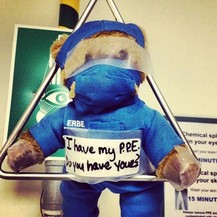
So, anyway, always always always wear your PPE!!!! It protects not only you, but your other patients and anyone you might bring the bacteria/virus home to!

Remember, safety first!
...Until next week!

Tuesday, October 14, 2014

Week 8: Evidence Based Practice

This past week, we studied two subjects that I am very passionate about - evidence based practice and patient education. Evidence based practice dictates what we do and how we do it. The first application of evidence based practice was in the 1800s when a physician noticed that women who delivered at home had much less rates of childbed fever (a septic infection that killed the moms a few days after they gave birth). The doctor started washing his hands before working with his patients (postpartum women). He quickly noticed that he too had much lower rates of childbed fever than other doctors in the area. Other doctors would go straight from an autopsy to the delivery room without washing their hands (yes, I know - DISGUSTING!). He told the other doctors to start washing their hands to protect their patients. However, the sad and scary thing is that the other doctors didn't like having to take the extra few seconds to wash their hands and so refused and even kicked the hand-washing doctor out of the country! Not surprisingly, the rates of childbed fever shot up again.


This week, we're having to write a paper about some form of evidence based practice and I (unsurprisingly) chose a childbirth related topic. In the year 2000, the Term Breech Trial released a report that significantly more babies born in the breech position died from being born vaginally than from Cesarean sections. Midwives were suddenly banned from attending breech deliveries and doctors stopped allowing vaginal breech births (except for the accidental ones where the mom walks into the hospital with her baby's butt hanging out...you get the picture).

Breech babies frequently keep their legs in this position for several days after birth.
Recently, childbirth professionals started looking more closely at the Term Breech Trial and discovered that their results aren't as obvious and dramatic as originally claimed. In fact, the trial tried to add mortality results from 3rd world countries (which already have high maternal and neonatal mortality rates regardless of how normal the birth is) with 1st world countries! Also, quite a few of the vaginal births used in the study violated the terms of the study. For instance, the study said the baby must be a non-footling breech (either frank or complete breech),  there must only be one baby (no twins!), the baby must be alive at the start of labor (you would think this one would be a "duh!" but read on...), the baby must not have any congenital defects (no heart or brain or chromosomal conditions), and the birth must be attended by an experienced birth attendant (again, another aspect you'd expect to be a "duh!").

Different types of breech positions - note the baby's feet

However, the study included several footling breeches, several sets of twins, several babies who were "probably" dead before their moms joined the study, at least one baby who had a congenital problem, and many of the births were NOT attended by experienced clinicians. Yet all the results - and resulting deaths -  were added to the study under the vaginal breech birth category. Also, the study "forgot" to mention that more moms died from a routine Cesarean section than from a vaginal birth.

Healthy mommy, healthy baby! :-D (And yes, in case you were wondering, I took this image)
For several years, a Cesarean became the only way to give birth to a breech baby. However, some European countries examined the study and conducted their own evaluations and discovered the Term Breech Trial results were wrong. When all results and extenuating circumstances are equal (healthy mom and baby, experienced birth attendant, resuscitation equipment ready, etc), the mortality rates were for babies were practically the same. However, the maternal mortality rates were significantly lower for moms having vaginal deliveries instead of Cesarean deliveries. Thankfully, some clinicians are starting to change their policies and "allow" vaginal breech births!

Once again, another picture I took :-D
If anyone wants to read the articles I'm using for my paper to validate what I wrote, the articles can be found here:
http://onlinelibrary.wiley.com/doi/10.1111/j.1523-536X.2011.00507.x/pdf
http://connection.ebscohost.com/c/articles/95894341/re-engaging-vaginal-breech-birth-philosophical-discussion
http://openaccess.city.ac.uk/3680/

...Until next week!